Wake up and smell the roses, because in a few years they will be gone..
Nature thrives on diversity; the more varied an ecosystem, the more resilient it becomes. Conversely, when a single species dominates, the entire system becomes vulnerable to collapse from disease or catastrophe. Beyond diversity, a community must maintain a "critical size" to remain self-sustaining. In ecology, this is known as the Allee effect: if a population drops below a specific threshold, its growth rate turns negative, leading to inevitable extinction without intervention.
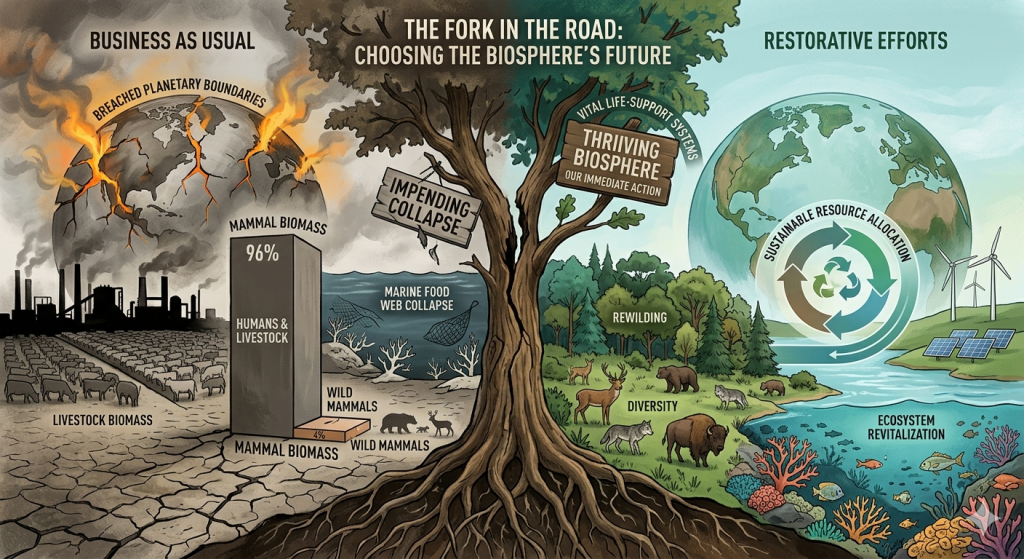
The human impact is staggering. While we have directly caused the extinction of roughly 5% of all species, 80% to 90% of the natural world has been destroyed since 1900 (73% just from 1970). Today, humans and domesticated livestock account for 95% of all mammal biomass on Earth. https://lnkd.in/efJgwF8K
As part of this global life-support system, we are bound by its rules, yet 99.99% of people overlook this dependency. Our over-exploitation and pollution don't just destroy wildlife; they destabilise the climate and lead to societal paralysis, causing conflict, disease and mass migration.
We have already passed 7 of the 9 global critical thresholds in the Earth's system that trigger self-perpetuating and irreversible change. https://lnkd.in/eFbxuWBZ.
If we continue with "business as usual", we face endpoints within the next 5 to 15 years. Ocean acidification, ecosystem destruction, and toxic pollution will lead to the loss of over 95% of nature, triggering societal collapse and catastrophic climate disruption and food shortages. https://lnkd.in/e4ezcHfP
While the situation is dire, practical solutions exist. However, we are out of time; we must act immediately to stop further harm and begin restorative efforts.