
Carbon dioxide is very important, and the health of marine life is a complementary concern
Carbon dioxide is very important for the climate, because rising carbon dioxide in the air is a main driver of the warming of the planet. It is also very important for the ocean, because the sea absorbs carbon dioxide from the air, and rising carbon dioxide lowers seawater pH and carbonate ion concentration, which reduces aragonite saturation.
Aragonite saturation measures how easily marine animals can build and maintain shells and skeletons of aragonite, which is a form of calcium carbonate. Aragonite dissolves below a saturation of 1, and the authors regard values between 1.6 and 1 as a marginal zone in which sensitive shell-building animals begin to suffer. Judged against reference thresholds that the authors chose for each ocean zone, and that are higher in warmer water, about 44% of the mapped ocean surface sat below its own winter threshold in the 2022 to 2024 winters. That figure stays between 37 and 52% under every zone layout the authors tested, and falling below a threshold marks risk and does not measure harm directly.
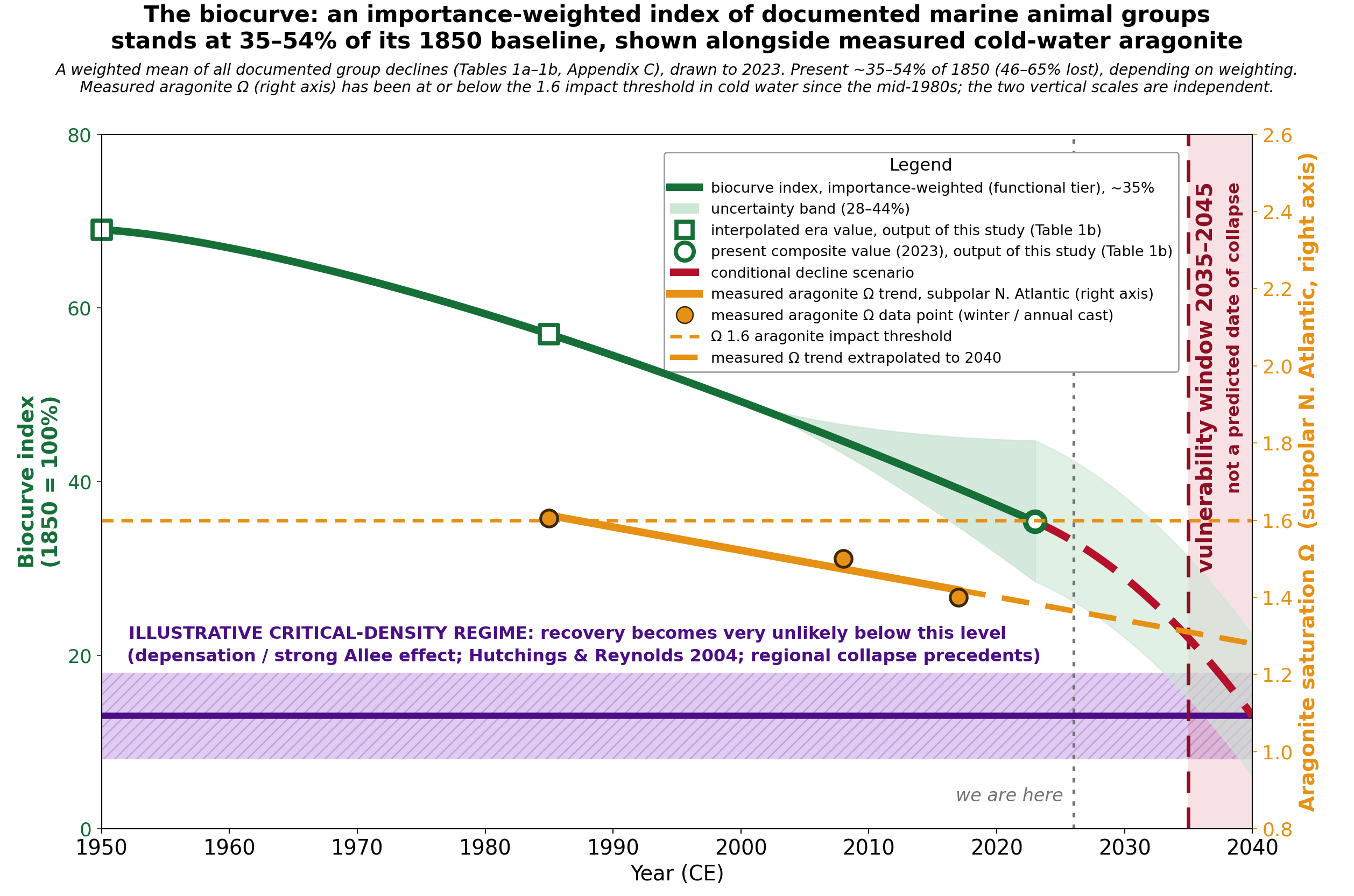
Carbon dioxide is not the only stress on marine life. An interpretive synthesis of documented declines places marine animal life at about 35 to 54% of its 1850 level, and most of that loss was recorded before acidification became a factor, so acidification, which rising carbon dioxide drives, is now acting on a system that fishing, whaling, habitat loss, pollution and climate disruption had already depleted.
Cutting carbon dioxide emissions is very important for the climate and for limiting ocean acidification. It would not, on its own, remove the black carbon, persistent pollutants that dissolve in fat, and plastic that are already in the ocean, or repair any damage to the microlayer, the thin skin at the surface of the ocean, because those materials act through biogeochemical and ecotoxicological pathways that are distinct from those of carbon dioxide.
Our plankton paper, a preliminary survey that was under review at the journal Ocean Science in October 2026, suggests that reducing marine pollution may protect the biological productivity of the ocean and may support ecosystem recovery in a way that complements cutting carbon dioxide emissions, although the survey itself did not test this idea.
The figure and the reports below have not completed peer review at a journal, and in October 2026 two of them were under review, the short version at BMC Marine Science and the plankton survey report at Ocean Science. They set out the work behind the statements about aragonite saturation, marine animal life and particles at the ocean surface.
An interpretive synthesis puts documented marine animal groups at about 35 to 54% of their 1850 level
The oceans cover about 71% of the planet and have absorbed most of the additional heat that rising greenhouse gas levels have trapped. I gave one of the first presentations at COP on the oceans and climate disruption.
The latest research from the GOES Foundation
Report 1: Ocean acidification and aragonite saturation compounding anthropogenic stressors on marine life
By Howard Dryden and Diane Duncan of the GOES Foundation. This is the long draft manuscript, and a shorter version of this work is a public preprint on Research Square that has not been peer reviewed by a journal.
Aragonite saturation is a key measure of ocean acidification, and the cold, productive waters that sustain most of the marine food web now have winter aragonite saturation and pH within the marginal zone for calcifying organisms (Ω 1.0 to 1.6). Reported annual means understate this decline, and judged against zone-specific ecological reference thresholds, 37 to 52% of the mapped ocean surface already sits below its winter threshold. An interpretive synthesis of documented declines places marine animal life at about 35 to 54% of its 1850 level, and most of that loss was recorded before acidification became a factor. Ocean acidification should therefore be treated as an active component of cumulative marine ecosystem risk, not solely as a future concern.
Report 2: Ocean acidification and aragonite saturation compounding anthropogenic stressors on marine life, short version
By Howard Dryden and Diane Duncan of the GOES Foundation. This is the short version of Report 1, and it was this short version that the authors submitted to the journal BMC Marine Science. The short version is also a public preprint on Research Square that has not been peer reviewed by a journal.
In the Iceland Sea, the subarctic North Pacific and the Southern Ocean, winter aragonite saturation already sits at or below 1.6, the threshold for sensitive aragonite calcifiers. About 44% of the mapped ocean surface was below its winter threshold in 2022 to 2024, a figure that stays between 37 and 52% under every zone layout the authors tested, and falling below a threshold marks risk and does not measure harm directly. An openly documented index of published declines places marine animal life at about 35 to 54% of its 1850 level, so acidification is acting on a system that fishing, whaling, habitat loss, pollution and climate disruption had already depleted.
Report 3: Zooplankton, phytoplankton and pervasive anthropogenic particles along a zonal tropical and subtropical North Atlantic transect: a multi-vessel citizen-science image survey
By Howard Dryden and Diane Duncan of the GOES Foundation. This revised manuscript was under review at the journal Ocean Science in October 2026, and the first version, titled “Near-absence of surface zooplankton and pervasive anthropogenic particles along a zonal North Atlantic transect: a multi-vessel citizen-science image survey”, is a public preprint on EGUsphere (egusphere-2026-3979).
In this preliminary citizen-science survey, thirteen sailing yachts crossing from the Canary Islands and Cape Verde to the Caribbean in January and February 2022 filtered half-litre samples of surface seawater. The filters were photographed under a microscope, and automated image analysis sorted 18,142 particles larger than 20 micrometres in 1,466 photographs, which together represent 146.6 litres of seawater. The sorting was checked by eye on 600 particles and repeated by a second scorer. Dark, combustion-like particles appeared in 70% of the photographs, plastic fibres in 27% and plastic fragments in 3%, alongside Saharan dust and plant debris, and almost all particles were smaller than 250 micrometres. Five animals, two copepods and three shrimps, were found in the samples, while separate plankton net tows over the same crossing caught 0.2 to 0.5 animals per cubic metre. All particle types were identified by their appearance alone and still need chemical confirmation. The survey provides a first baseline for this ocean region and shows how yacht crews could help to monitor pollution at the ocean surface.
Report 4: The collapse of the marine ecosystems
By Howard Dryden of the GOES Foundation. This report has not been peer reviewed by a journal.
This report compares the five great crises of the last 265 million years, in which a large pulse of carbon, or in one case an asteroid impact, changed the chemistry of seawater, with the ocean of today. It uses two measures, the aragonite saturation of surface water and the share of marine life that was lost. The report concludes that the modern ocean started from a weaker chemical position than in any of the past events, that its chemistry is now changing faster, and that its animal life has already fallen by between about one half and two thirds since 1850.