

www.goesfoundation.com

A child was walking along a beach after a storm and found it covered in starfish. Upset at the sight, the child started putting them back in the water one by one. An old man came up and said, “What are you doing? There are thousands of starfish-way too many to make a difference.” The child looked at the old man, picked up a starfish, put it in the ocean, and said. “It made a difference to that one”.
If we all do something, such as stop using cosmetics containing oxybenzone or reduce the use of plastic, it will make a difference
Carbon dioxide is very important for the climate, because rising carbon dioxide in the air is a main driver of the warming of the planet. It is also very important for the ocean, because the sea absorbs carbon dioxide from the air, and rising carbon dioxide lowers seawater pH and carbonate ion concentration, which reduces aragonite saturation.
It is now time to implement real solutions and take action....
What are plankton?
Plants (phytoplankton) and animals (zooplankton) are included in the term plankton, which comes from the Latin word for "ocean drifter". Copepods are zooplankton from the Subphylum Crustacea; there are 13,000 Copepod species; and this is also the name of our research vessel. We are the only Copepod yacht in the world.
Our vision and mission is to restore the health of our oceans, mitigate climate change, and return our planet to its natural state prior to the Chemical Revolution, which began in the 1950s with the production of toxic chemicals and plastic.
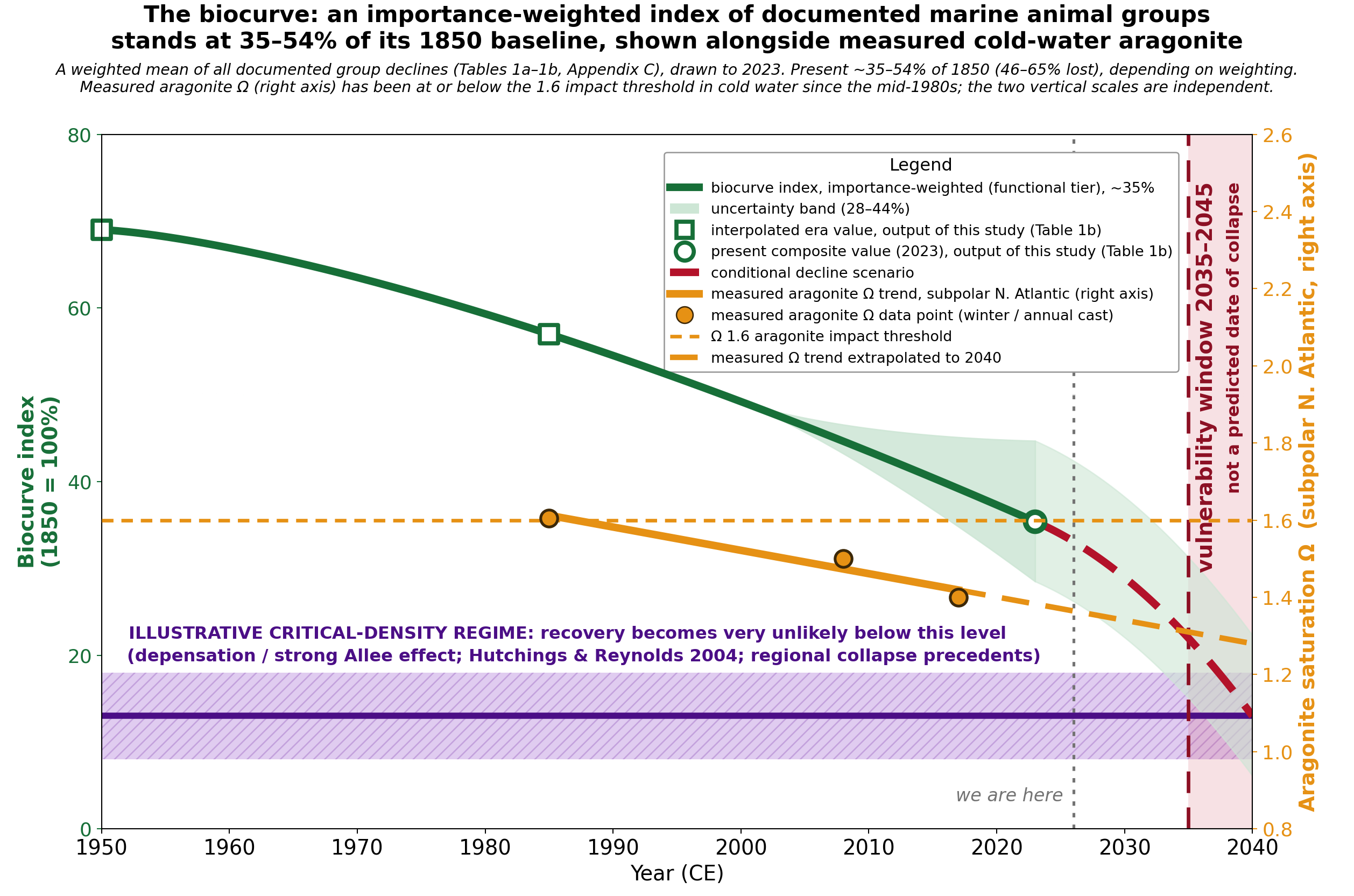
Carbon dioxide is not the only stress on marine life. An interpretive synthesis of documented declines places marine animal life at about 35 to 54% of its 1850 level, and most of that loss was recorded before acidification became a factor, so acidification, which rising carbon dioxide drives, is now acting on a system that fishing, whaling, habitat loss, pollution and climate disruption had already depleted.
The GOES Foundation's mission is to eliminate microplastics, partially combusted carbon, and toxic chemical pollution from the oceans.
Few people have heard of marine copepods, which are tiny marine crustaceans measuring about 1mm in size.
Copepods

5 gigatons of these 1mm-sized zooplankton called COPEPODS live in all the world's Oceans. This is equivalent to 17 million 747 jets, and if you laid the jets end to end, they would go around the planet 31 times.
The copepods migrate from around 200m below the ocean surface every night to feed on plants (phytoplankton) at the surface. It is the greatest mass migration of animals on the planet, and it happens twice a day. The vertical motion of the copepods moves just about as much water as the moon and the tides.
A study of long-term observations found that krill in the North Atlantic have roughly halved since 1958, mainly through warming and a squeezed habitat. We are now even contemplating dredging the ocean floor!
Cutting carbon dioxide emissions is very important for the climate and for limiting ocean acidification. It would not, on its own, remove the black carbon, persistent pollutants that dissolve in fat, and plastic that are already in the ocean, or repair any damage to the microlayer, the thin skin at the surface of the ocean, because those materials act through biogeochemical and ecotoxicological pathways that are distinct from those of carbon dioxide.
Our plankton paper, a preliminary survey that was under review at the journal Ocean Science in October 2026, suggests that reducing marine pollution may protect the biological productivity of the ocean and may support ecosystem recovery in a way that complements cutting carbon dioxide emissions, although the survey itself did not test this idea.
Copepods churn the oceans; https://www.snexplores.org/article/small-swimmers-may-play-huge-role-churning-seas
Our current reports
Our reports are described on the climate change page, which links to the Research Square preprint and the EGUsphere preprint, and on 4 October 2026 neither report had completed peer review.
THE BAD NEWS
Aragonite saturation measures how easily marine animals can build and maintain shells and skeletons of aragonite, which is a form of calcium carbonate. Aragonite dissolves below a saturation of 1, and the authors regard values between 1.6 and 1 as a marginal zone in which sensitive shell-building animals begin to suffer. Judged against reference thresholds that the authors chose for each ocean zone, and that are higher in warmer water, about 44% of the mapped ocean surface sat below its own winter threshold in the 2022 to 2024 winters. That figure stays between 37 and 52% under every zone layout the authors tested, and falling below a threshold marks risk and does not measure harm directly.
We cannot survive without healthy oceans, and common sense tells us that we must stop poisoning them with toxic chemicals and plastic.
sunscreen, pharmaceuticals, care tyres, plastic, herbicides, pesticides, PCBs, PBDE
When it comes to our planet's deteriorating health, the dominant focus has been on rising carbon dioxide levels caused by the use of fossil fuels. We must reduce carbon emissions while also eliminating toxic chemical pollution. The oceans are the planet's lungs, but since the 1950s and the production of herbicides and pesticides, the oceans have been suffocating under a toxic chemical cocktail. Every type of household cleaner and personal care product contains marine toxic chemicals. Thousands of different toxic chemicals are now being manufactured around the world, killing plankton and impeding their ability to produce oxygen and remove carbon dioxide from the atmosphere.
Reducing ocean pollution may complement cutting carbon dioxide emissions
The oceans cover about 71% of the planet and have absorbed most of the additional heat that rising greenhouse gas levels have trapped.
Rising carbon dioxide in the air is a main driver of the warming of the planet, so cutting carbon dioxide emissions is very important.
We must restore our oceans.
Cutting carbon dioxide emissions and reducing marine pollution are complementary actions, and reducing marine pollution may support ecosystem recovery.

THE GOOD NEWS
The deep ocean is by far the largest carbon bank on the planet. When marine life dies, it falls into the abyss and is trapped for thousands of years. The good news is that most marine life is less than 1mm in size and has a doubling time of only three days.
Reducing marine pollution may support ecosystem recovery in a way that complements cutting carbon dioxide emissions, although our plankton survey did not test this idea.
Universal sea change necessitates global participation. AND it's simple for you to assist. Whether you're in a position of power, sailing the seas, or simply want to change a few bad purchasing habits and help protect the world you live in, it's time to make a change — go non-toxic!
The GOES Foundation is acting quickly to lead the necessary and universal sea change required to address climate change. We are working around the world to stem the toxic tide that is polluting our oceans.
GOES involves people and organisations at all levels of society, from children to world leaders and daring adventurers who sail across the oceans at high and low latitudes to collect plankton samples.
GOES employs all available digital technology and artificial intelligence (AI) tools to demonstrate the urgent need to eliminate all toxic chemicals, hazardous waste, and plastics from homes and industry.
We should simply stop using highly toxic chemicals as a precautionary measure or as a reality check. GOES will collect thousands of samples in order to provide irrefutable evidence to policymakers, allowing them to make faster decisions and get these chemicals out of our lives.
Copepod photo of the Ria Formosa in Southern Portugal, one of the last remaining sea-horse sanctuaries
-
In comparison to Copepods; climate change is insignificant
5 gigatons of these 1 mm-sized zooplankton called COPEPODS live in all the world’s oceans. This is equivalent to 17 million 747 jets, and if you laid the jets end to end, they would go around the planet 31 times. The copepods migrate from around 200m below the ocean surface every night to feed on…
-
A transformational approach to regenerate the marine ecosystem and address climate disruption by employing the agrotech sector and increasing crop productivity by using olivine.
-
A PRELIMINARY LAND SNAIL SURVEY OF SEAHORSE POINT NATURE RESERVE, ISLA BASTIMENTOS, PANAMA, CENTRAL AMERICA
-
In comparison to Copepods; climate change is insignificant
5 gigatons of these 1 mm-sized zooplankton called COPEPODS live in all the world’s oceans. This is equivalent to 17 million 747 jets, and if you laid the jets end to end, they would go around the planet 31 times. The copepods migrate from around 200m below the ocean surface every night to feed on…
-
A transformational approach to regenerate the marine ecosystem and address climate disruption by employing the agrotech sector and increasing crop productivity by using olivine.
-
A PRELIMINARY LAND SNAIL SURVEY OF SEAHORSE POINT NATURE RESERVE, ISLA BASTIMENTOS, PANAMA, CENTRAL AMERICA